Failed cancer immunotherapies cost Medicare hundreds of millions. How should FDA revamp accelerated approvals?


Standard clinical trials for new cancer therapies can take an average of six to seven years prior to regulatory approval, time that does not jibe with the realities of a cancer diagnosis, where time and pinpointing an effective treatment are the priority.
Since 1983, the Food and Drug Administration has introduced various initiatives to shorten the drug approval process. In 1992, the FDA launched the accelerated approval pathway to facilitate the fast-tracked approval of new treatments based on early predictors of benefit (called surrogate endpoints), rather than the outcomes of lengthy trials. But as long as this program has endured, so too, has a sensitive question: how much certainty about a drug’s effectiveness should be sacrificed in the name of speed?
For health economists, including the Institute’s Mahnum Shahzad, this compromise requires ongoing, careful analysis.
“As an economist, I think a lot about tradeoffs. This is why these pathways, especially the accelerated approval pathway, are so interesting to me. There, the tradeoff is explicit: we gave up certainty of benefit for early access,” she says.
That tradeoff itself, she points out, is not inherently problematic. There are cases—particularly when patients have few or no treatment options—where earlier access to a potentially effective drug can be life-changing.
But the heavy reliance on surrogate endpoints, factors such as tumor shrinkage, which are believed to predict clinical outcomes like longer survival, are often imperfect proxies. Dr. Shahzad believes that the key decision makers (patient and physician) should have access to the best information when considering the available options.
As an economist, I think a lot about tradeoffs. This is why these pathways, especially the accelerated approval pathway, are so interesting to me. There, the tradeoff is explicit: we gave up certainty of benefit for early access.
If these parties don’t fully understand the weaknesses of the data behind many approvals, the system has failed, she notes.
Research and clinical experience suggest that both patients and physicians often overestimate the magnitude and certainty of those benefits. “The narrative around cancer drug development can be tricky, and sometimes misleading – in both directions,” says Dr. Shahzad. “On one hand, terms like ‘breakthrough therapy’ tend to mask the uncertainties of the available evidence. On the other, I think there’s also a perception that promising therapies are being hindered by stringent regulations, while in reality there's a lot of flexibility.”
The gap between early approval and definitive evidence of clinical benefit has become one of the central points of alarm among policymakers and clinicians.
According to the regulations, manufacturers are required to follow accelerated approvals with confirmatory trials to verify whether a drug delivers meaningful clinical benefit. However, those trials are not always completed on time—or at all. Identifying which drugs are most likely to experience delays in confirmatory evidence is a critical, ongoing challenge, and was also the focus of Dr. Shahzad’s dissertation research. That work resulted in a JAMA Research Letter suggesting that if confirmatory studies are started before a drug is approved through the accelerated pathway, there is a higher likelihood of completing these trials on time.
Dr. Shahzad and many of her colleagues have been strong supporters of confirmatory trials being completed on time. Once a drug has been approved for use, even via the accelerated pathway, it’s a difficult and slow process to reverse that decision if the post-approval data suggests it is ineffective.
If proven to show a lack of clinical benefit, an accelerated approval pathway drug will undergo either a voluntary withdrawal (the manufacturer opts proactively to take the drug off the market, often after negotiations with the FDA) or an involuntary withdrawal (the FDA issues a notice to the manufacturer, offering the opportunity to begin a more lengthy regulatory negotiation and appeals process). Both processes can take years.
In the meantime, patients continue using—and paying for—treatments whose effectiveness may remain uncertain or even disproven. Dr. Shahzad points to her recent study on withdrawn ovarian cancer treatment indications, which highlights an example of delays between the release of negative evidence and withdrawal of an indication and suggests lessons for the accelerated pathway.
The stakes of these decisions also carry significant financial implications. The United States spends billions annually on cancer drugs, including a growing share on therapies that offer uncertain—or, in some cases, no—demonstrated benefit. “It is striking how much money is spent on drugs where the benefit is uncertain or negative,” she notes. While the FDA evaluates the safety and efficacy of the drugs, pricing decisions are largely left to the market. As a result, expensive drugs with limited evidence of benefit can still enter widespread use.
For instance, Dr. Shahzad led a study exploring the estimated Medicare spending on the 10 cancer drugs that received accelerated approval and were then reevaluated by the FDA in 2021, all of which were found to lack evidence of overall survival benefit. The team found that approximately $224 million of Medicare Parts B and D spending was for indications that were either voluntarily withdrawn by the manufacturers or recommended for withdrawal after evidence of lack of benefit was made public. This reality underscores the need for reforms that better align incentives with outcomes.
As a former research fellow and now a faculty member within the Institute’s Division of Health Policy and Insurance Research (HPI), Dr. Shahzad has performed her research under the mentorship of, and now in collaboration with physicians, epidemiologists, pharmacologists, lawyers, and other economists, building a solid portfolio of scholarship.
One research goal, she says, is to build awareness of the other complex issues surrounding many cancer drugs. For instance, cancer drugs are a protected class under Medicare, requiring that many of the fast-tracked drugs must be covered. Oncology medications have also had significant off-label usage, which can contribute to high healthcare spending and inconsistent access. Complex issues require a creative lens; she believes that the Institute’s relationship with Point32Health is uniquely valuable because it allows her and her fellow investigators to engage directly with a payer and understand its constraints—insights that are difficult to infer from plan data alone. Gaining this deeper understanding is essential for developing meaningful solutions to this complicated issue.
Ultimately, Dr. Shahzad aims to produce actionable insights that can move decision making around expedited approvals and the processes that govern them in the right direction. She views policymakers and regulators as her primary audience—and therefore aims to ensure that her research is responsive to their needs.
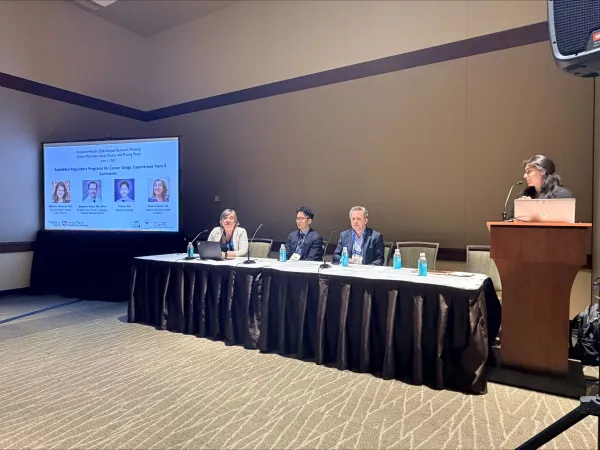
Striking the balance between affordability, access, and evidence is a challenge not unique to the United States. Pharmaceutical manufacturers and markets span the globe, and regulatory agencies in Europe and China are just two also grappling with the same questions. Open dialogues among these parties are key, notes Dr. Shahzad, who led one of these critical conversations at a panel at the recent AcademyHealth Research Meeting in Seattle, WA. One strength of the panel, she notes, was the participation of Melanie Wyne, Chief Policy Officer at the National Breast Cancer Coalition, and a breast cancer survivor.
“I think the patient voice is essential in these discussions,” says Dr. Shahzad. “In this instance, Melanie’s experience as a cancer survivor, combined with her policy expertise, lent a distinctive perspective to what patient needs regulatory bodies should be attentive to.”
Overall, Dr. Shahzad notes, expedited approval pathways reflect a fundamental societal choice: how much uncertainty we are willing to accept in exchange for speed. For patients in urgent need, faster access can offer hope. But as the system evolves, ensuring that the promise of new therapies is matched by real, measurable benefit remains one of the most pressing questions.
