Project Viva - Women's Health Cohort
- National Institutes of Health (NIH)
- SCORE: Physiologic and Social Stressors and Health during the Menopausal Transition

Project Summary
Project Viva is a groundbreaking longitudinal research study of women and children that began in 1999. The initial goal of Project Viva was to find ways to improve the health of mothers and their children by looking at the effects of mother's diet as well as other factors during pregnancy and after birth. Over the past two decades, Project Viva has expanded its focus to include a wider range of experiences that influence health extending into midlife for the mothers. Health exposures of interest now include not only diet but also physical activity, sleep, environmental chemicals, air pollution, stressors, mental health, and others. The information we collect enables us to investigate, for example, the effects of a mother's diet during pregnancy. Project Viva began enrolling pregnant women in April of 1999. Project Viva continues to conduct in-person visits with mom participants (now in their mid-life years) and sends out annual surveys to track the changes of participants throughout the years.
Interested in Using Project Viva Data for Your Study?
The HPHCI Administrative Data Service Center (ADSC) offers an opportunity for investigators not subcontracting to HPHCI to request Project Viva datasets for their work. We welcome proposals by new investigators interested in using the Project Viva data and offer expert administrative and analytic services to prepare datasets for use through the Institute Administrative Data Services Center (ADSC).
Study Population
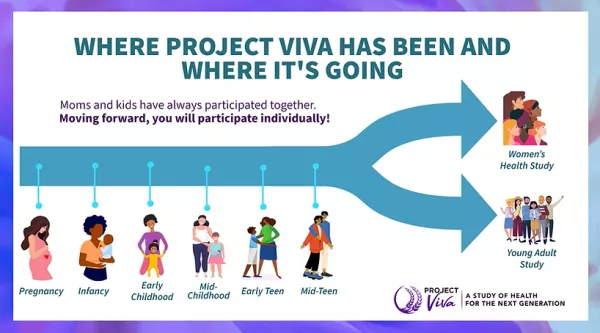
A total of 2,128 babies born between 1999 and 2003 were enrolled into Project Viva. Today, more than two decades later, over 1,000 women continue to be actively engaged in Project Viva research! Project Viva mothers completed in-person examinations during pregnancy, and were seen together with their children at study visits throughout childhood and into the teen years. Project Viva now invites mothers and their children to continue their participation as individuals, as we shift our focus toward separate studies of Young Adult health and Women’s health.
Aims
Research involving Project Viva moms is currently being funded by the following two grants:
The Center for Reproductive Outcomes of Stress and Aging, or ROSA, is an NIH-funded research center that assembles a collaborative network of leading investigators across Beth Israel Deaconess Medical Center (BIDMC), Brigham and Women’s Hospital (BWH), Harvard Medical School (HMS), and Harvard Pilgrim Health Care Institute (HPHCI). The Center is one of ten Specialized Centers of Research Excellence (SCORE) on Sex Differences nationwide.
The grant focuses on stress exposures and how neural regulation transmits stress to worsen women’s health during and after menopause. More specifically, within Project Viva, investigators will look at how two types of stress – artificial light at night (ALAN) and social stress – affect brain and cognitive skills over time, by looking at the following neurocognitive outcomes:
- Aim 1: Menopausal symptoms and timing, assessed with validated questionnaires;
- Aim 2: Sleep, including duration, quality, and fragmentation, assessed with week-long electronic diary, wrist actigraphy, and questionnaires;
- Aim 3: Mood, including depressive and anxiety symptoms assessed with validated questionnaires as well as clinical diagnoses and treatment; and
- Aim 4: Cognition, assessed with validated tests and self-report.
The aim of this grant is to evaluate how different aging measures relate to chronic disease risk in midlife women. Exposures include:
- Reproductive aging: clinical indicators (e.g., age at menarche and menopause, reproductive lifespan, pregnancy history) and molecular markers (anti-Müllerian hormone [AMH]).
- Biological aging: epigenetic age deviation (EAD), mitochondrial DNA copy number, and telomere length.
- Chronological aging: calendar age.
It will involve assessing the following outcomes:
- Aim 1: Cognitive function (objective and self-reported) using MoCA, CANTAB, and ECog-12.
- Aim 2: Physical frailty, including handgrip strength, muscle mass and bone density (DXA), and Short Performance Physical Battery (SPPB) performance.
- Aim 3: Cardiometabolic risk, including adiposity, blood pressure, lipids, glycemia, and self-reported conditions (type 2 diabetes, dyslipidemia, hypertension).
- Aim 4: Exploratory analysis of interactions among reproductive, biological, and chronological aging measures in relation to these outcomes.
Investigators will use 25 years of carefully collected data and add new measurements of genome-wide DNA methylation in this group for the first time. This will allow investigators to estimate epigenetic aging. The findings will help improve how to predict chronic disease risk in women beyond just their age.